December 18, 1915, City Times, Galveston, Texas
ENTERTAINING ON CHRISTMAS
The Christmas season brings to mind the many Christmas days gone by, with their four great features—turkey, cranberry sauce, plum pudding and mince pie.
It was a good old English custom, not to be rejected by the American colonists, although modificatlons were necessary to suit the religion and conditions of living in the colonies, the. Chrlst-splrlt being substituted for the pagan Yuletlde, the famous "boar's, head" was omitted, and the Christmas pie became known as-mince pie. However, many old observances were kept, including the mistletoe and holly, and Christmas was a day for family gatherings, with a feast prepared by the" women of the house.
Showing posts with label Traditions. Show all posts
Showing posts with label Traditions. Show all posts
Monday, December 7, 2009

Tuesday, November 17, 2009
Speaking of "Home for the Holidays"
While Christmas movies are a dime a dozen, there are precious few movies that focus on that other venerable holiday here in the U.S.: Thanksgiving. There is one, however, which is very funny - and maybe a bit too "close to home" if your family tends towards "dysfunctional."
Monday, December 8, 2008
Virgin Wassail Bowl (no alcohol)

VIRGIN WASSAIL BOWL
- 1 cup brown sugar
- 12 whole cloves
- 2 Tbsp (or more) ground cinnamon
- 2 lemons, sliced thin
- 2 oranges, sliced thin
- 1 apple, sliced thin
- 1 gallon sweet cider
- 1 pint 7-Up or ginger ale
Make syrup of brown sugar and 1 cup water; add cloves and cinnamon.
Simmer for 10 minutes; add fruit. Simmer for 10 minutes longer with
cider; do not boil. Add 7-Up just before serving. Serve in mugs with
cinnamon stick. Yield: 20 servings.
Saturday, December 6, 2008
How to say "Merry Christmas" in different languages
Afrikaans - Geséende Kersfees
Albanian - Gèzur Krishlindyet
Amharic - Melkame Yeledet Beale
Arabic - Idah Saidan Wa Sanah Jadidah
Armenian - Shenorhavor Dzenount
Azeri - Tezze Iliniz Yashi Olsun
Bamoun - Poket Kristmet
Bengali - Shuvo Boro Din
Basque - Zorionak eta Uret Berri On
Belgian - Vrolkjke Kerstmis
Bohemian - Vesele Vanoce
Breton - Nedeleg laouen
Bulgarian - Tchestita Koleda
Cornish - Nadelik looan na looan blethen noweth
Croatian - Srecan Bozic
Czech - Veselé Vánoce
Danish - Glædelig Jul
Dutch - Vrolijk Kerstfeest
English - Merry Christmas
PC English - Happy Holidays
Esperanto - Gajan Kristnaskon
Eritrean - Rehus-Beal-Ledeats
Estonian - Häid jõule
Farsi - Cristmas-e-shoma mobarak bashad
Filipino - Maligayang Pasko
Finnish - Hyvää joulua
French - Joyeux Noèl
Frisian - Goede Krystdagen
Gaelic - Nollaig Chridheil
Georgian - Gilotsavt Krist'es Shobas
German - Froehliche Weihnachten
Greek - Kala Christouyenna
Guarani - V'ya pave mita tupara-pe
Hausa - Barka da Kirsìmat
Hawaiian - Mele Kalikimaka
Hindi - Shub Naya Bara
Hungarian - Kellemes Karácsonyi ünnepeket
Icelandic - Gledileg Jól
Indonesian - Selamat Hari Natal
Irish - Nollaig Shona Dhuit
Italian - Buon Natale
Japanese - Kurisumasu Omedeto
Korean - Sung Tan Chuk Ha
Latin - Felice Festa Navititas
Latvian - Prieci'gus Ziemsve'tkus
Lithuanian - Linksmu Kalédu
Luxembourg - Schéi Chrèschtdeeg
Manx - Nollick ghennal
Malta - Il-Milied-It-Tajjeb
Marathi - Shub Naya Varsa
Norwegian - God Jul
Polish - Wesolych Swiat
Portuguese - Boas Festas
Romanian - Sarbatori vesele
Romansh - Bellas Festas
Russian - Hristos Razdajetsja
Sami - Buorre Juovllaid
Samoan - Ia manjia le Kerisimasi
Serbian - Hristos se rodi
Singhalese - Subha nath thalak Vewa
Slovak - Veselé Vianoce
Slovene - Vesele Bozince
Spanish - Feliz Navidad
Swedish - God Jul
Tahitian - Ia ora it te Noera
Tamil - Nathar Puthu Varuda Valthukkal
Thai - Sawadee Pee Mai
Turkish - Noeliniz Ve Yeni Yiliniz Kuthu Olsun
Ukrainian - Srozhdestvom Kristovym
Urdu - Naya Saal Mubarak Ho
Vietnamese - Chung Mung Giangh Sinh
Welsh - Nadolig Llawen
Albanian - Gèzur Krishlindyet
Amharic - Melkame Yeledet Beale
Arabic - Idah Saidan Wa Sanah Jadidah
Armenian - Shenorhavor Dzenount
Azeri - Tezze Iliniz Yashi Olsun
Bamoun - Poket Kristmet
Bengali - Shuvo Boro Din
Basque - Zorionak eta Uret Berri On
Belgian - Vrolkjke Kerstmis
Bohemian - Vesele Vanoce
Breton - Nedeleg laouen
Bulgarian - Tchestita Koleda
Cornish - Nadelik looan na looan blethen noweth
Croatian - Srecan Bozic
Czech - Veselé Vánoce
Danish - Glædelig Jul
Dutch - Vrolijk Kerstfeest
English - Merry Christmas
PC English - Happy Holidays
Esperanto - Gajan Kristnaskon
Eritrean - Rehus-Beal-Ledeats
Estonian - Häid jõule
Farsi - Cristmas-e-shoma mobarak bashad
Filipino - Maligayang Pasko
Finnish - Hyvää joulua
French - Joyeux Noèl
Frisian - Goede Krystdagen
Gaelic - Nollaig Chridheil
Georgian - Gilotsavt Krist'es Shobas
German - Froehliche Weihnachten
Greek - Kala Christouyenna
Guarani - V'ya pave mita tupara-pe
Hausa - Barka da Kirsìmat
Hawaiian - Mele Kalikimaka
Hindi - Shub Naya Bara
Hungarian - Kellemes Karácsonyi ünnepeket
Icelandic - Gledileg Jól
Indonesian - Selamat Hari Natal
Irish - Nollaig Shona Dhuit
Italian - Buon Natale
Japanese - Kurisumasu Omedeto
Korean - Sung Tan Chuk Ha
Latin - Felice Festa Navititas
Latvian - Prieci'gus Ziemsve'tkus
Lithuanian - Linksmu Kalédu
Luxembourg - Schéi Chrèschtdeeg
Manx - Nollick ghennal
Malta - Il-Milied-It-Tajjeb
Marathi - Shub Naya Varsa
Norwegian - God Jul
Polish - Wesolych Swiat
Portuguese - Boas Festas
Romanian - Sarbatori vesele
Romansh - Bellas Festas
Russian - Hristos Razdajetsja
Sami - Buorre Juovllaid
Samoan - Ia manjia le Kerisimasi
Serbian - Hristos se rodi
Singhalese - Subha nath thalak Vewa
Slovak - Veselé Vianoce
Slovene - Vesele Bozince
Spanish - Feliz Navidad
Swedish - God Jul
Tahitian - Ia ora it te Noera
Tamil - Nathar Puthu Varuda Valthukkal
Thai - Sawadee Pee Mai
Turkish - Noeliniz Ve Yeni Yiliniz Kuthu Olsun
Ukrainian - Srozhdestvom Kristovym
Urdu - Naya Saal Mubarak Ho
Vietnamese - Chung Mung Giangh Sinh
Welsh - Nadolig Llawen
Friday, November 28, 2008
Tuesday, November 18, 2008
The First Christmas Card
In the early 19th century it was common for schoolboys to showcase their penmanship skills by producing elegant decorative notepaper for family use in writing friends and relatives during the holiday season. Perhaps an offshoot of this was the Valentine's card mania, which started in Britain in the 1820s and gradually spread to the U.S. and Canada.
It was not until 1843, however, that this notion of sending cards spread to Christmas. That year, Henry Cole (1808-82), English businessman and patron of the arts, enlisted the services of English artist John Horsley to produce 1000 Christmas-themed cards that he could give to his friends and business associates. The result was the portrait of a family enjoying a cup of punch, framed by depictions of charity: feeding and clothing the poor.
At a shilling each, a card such as this was too expensive for the average commoner; however, the 1850s saw the mass-production of Christmas cards accompanied by cheap postal rates, and so the practice of sending Christmas cards began in earnest. And it has persisted to this day.
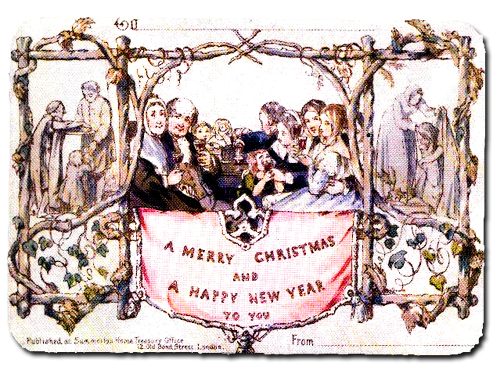
It was not until 1843, however, that this notion of sending cards spread to Christmas. That year, Henry Cole (1808-82), English businessman and patron of the arts, enlisted the services of English artist John Horsley to produce 1000 Christmas-themed cards that he could give to his friends and business associates. The result was the portrait of a family enjoying a cup of punch, framed by depictions of charity: feeding and clothing the poor.
At a shilling each, a card such as this was too expensive for the average commoner; however, the 1850s saw the mass-production of Christmas cards accompanied by cheap postal rates, and so the practice of sending Christmas cards began in earnest. And it has persisted to this day.
Monday, November 17, 2008
Wassailing
We tend to think of "Wassailing" as the old English tradition of going from house-to-house at Christmas with a wassail bowl either offering a drink and expecting a gratuity in return, or simply expecting the bowl to be filled with drink. This is accurate, but Wassailing was more than that. The term "wassail" comes from the Anglo-Saxon toast waes hael, which means "good health." The customary reply when such a kind wish was proffered upon one was to reply drinc heil, or "drink well." Equally important, however, was the time-honored tradition of wassailing the farm animals and fruit trees, the idea being that drinking to the health of the livestock or the crops would ensure bounteous production in the coming year.
There are many old Wassailing songs, among them the following verses which illustrate the practice of drinking a toast to the farm animals, as well as the jovial (and doubtless inebriated) going from house to house seeking a drink at Christmastide.
Wassail, Wassail
Wassail, Wassail, all over the town!
Our toast it is white, and our ale it is brown,
Our bowl it is made of the white maple tree;
With the wassailing bowl we'll drink to thee.
So here is to Cherry and to his right cheek,
Pray God send our master a good piece of beef,
And good piece of beef that may we all see;
With the wassailing bowl we'll drink to thee.
And here is to Dobbin and to his right eye,
Pray God send our master a good Christmas pie,
And good Christmas pie that may we all see;
With our wassailing bowl we'll drink to thee.
So here is to Broad May and her broad horn,
May God send our master a good crop of corn,
And a good crop of corn that may we all see;
With the wassailing bowl we'll drink to thee.
And here is to Fillpail and her left ear,
Pray God send our master a happy New Year,
And a happy New Year as e'er he did see;
With our wassailing bowl we'll drink to thee.
And here is to Colly and to her long tail,
Pray God send our master he never may fail,
A bowl of strong beer; I pray you draw near,
And our jolly wassail it's then you shall hear.
Come butler, come fill us a bowl of the best,
Then we hope that your soul in heaven may rest;
But if you do draw us a bowl of the small,
Then down shall go butler, bowl and all.
Then here's to the maid in the lily white smock,
Who tripped to the door and slipped back the lock!
Who tripped to the door and pulled back the pin,
For to let these jolly wassailers in.
- Anonymous
There are many old Wassailing songs, among them the following verses which illustrate the practice of drinking a toast to the farm animals, as well as the jovial (and doubtless inebriated) going from house to house seeking a drink at Christmastide.
Wassail, Wassail
Wassail, Wassail, all over the town!
Our toast it is white, and our ale it is brown,
Our bowl it is made of the white maple tree;
With the wassailing bowl we'll drink to thee.
So here is to Cherry and to his right cheek,
Pray God send our master a good piece of beef,
And good piece of beef that may we all see;
With the wassailing bowl we'll drink to thee.
And here is to Dobbin and to his right eye,
Pray God send our master a good Christmas pie,
And good Christmas pie that may we all see;
With our wassailing bowl we'll drink to thee.
So here is to Broad May and her broad horn,
May God send our master a good crop of corn,
And a good crop of corn that may we all see;
With the wassailing bowl we'll drink to thee.
And here is to Fillpail and her left ear,
Pray God send our master a happy New Year,
And a happy New Year as e'er he did see;
With our wassailing bowl we'll drink to thee.
And here is to Colly and to her long tail,
Pray God send our master he never may fail,
A bowl of strong beer; I pray you draw near,
And our jolly wassail it's then you shall hear.
Come butler, come fill us a bowl of the best,
Then we hope that your soul in heaven may rest;
But if you do draw us a bowl of the small,
Then down shall go butler, bowl and all.
Then here's to the maid in the lily white smock,
Who tripped to the door and slipped back the lock!
Who tripped to the door and pulled back the pin,
For to let these jolly wassailers in.
- Anonymous
Tuesday, November 11, 2008
Meatless Mincemeat

Chopped beef and beef suet have been a significant ingredient of mince pies since day one, hence the name mincemeat. A 17th century poem contains a verse which reads:
Drink now the strong beer,
Cut the white loaf here,
The while the meat is a-shredding;
For the rare mince pie
And the plums stand by
To fill the paste that's a-kneading.
Traditional Old English Mincemeat is well and good for some, but for those who don't eat meat, and for those who shudder at the dietary implications of introducing yet more fat into a holiday diet already high in fat and calories, here is a meatless alternative. In addition to being meat-free, the recipe is also much less involved than the traditional alternative.
Note: Not everyone will like mince pie. As a general rule, I would offer that if you don't like marmalade, fruitcake, or raisins, then there's a good chance you won't like mince pie.
Ingredients:
This recipe is sufficient for 3 to 4 nine-inch pies, using 3-4 cups mincemeat per pie. Halving all ingredients should make enough mincemeat for two pies.
- 1 seeded orange
- 1 seeded lemon
- 1-1/2 cups golden raisins
- 1-1/2 cups dried currants
- 8 tart apples (Granny Smith are good)
- 3/4 cup mixed candied fruit peel, diced
- 1-3/4 cups apple cider
- 3-1/2 cups firmly packed dark brown sugar
- 1 tsp. salt
- 1-1/2 teaspoons each powdered: cinnamon, allspice, mace, nutmeg & cloves
- Optional: Brandy, rum, sherry, or whiskey to taste.
Saturday, November 8, 2008
"The Mistletoe" (circa 1815-30)
THE MISTLETOE

When winter nights grow long,
And winds without grow cold,
We sit in a ring round the warm wood-fire
And listen to stories old!
And we try to look grave (as maids should be)
When the men bring the boughs of the Laurel tree.
O the Laurel, the evergreen tree!
The poets have laurels, and why not we?
How pleasant, when night falls down
And hides the wintry sun,
To see them come in to the blazing fire,
And know that their work is done;
Whilst many bring in, with a laugh or rhyme,
Green branches of Holly for Christmas time!
O the Holly, the bright green Holly,
It tells (like a tongue) that the times are jolly!
Sometimes (in our grave house,
Observe, this happeneth not),
But, at times the evergreen laurel boughs
And the holly are all forgot!
And then! what then? why, the men laugh low,
And hang up a branch of the mistletoe!
O brave is the laurel! and brave is the holly!
But the Mistletoe banisheth melancholy!
Ah, nobody knows, nor ever shall know,
What is done--under the Mistletoe.
- Bryan Waller Procter (1787-1874)


When winter nights grow long,
And winds without grow cold,
We sit in a ring round the warm wood-fire
And listen to stories old!
And we try to look grave (as maids should be)
When the men bring the boughs of the Laurel tree.
O the Laurel, the evergreen tree!
The poets have laurels, and why not we?
How pleasant, when night falls down
And hides the wintry sun,
To see them come in to the blazing fire,
And know that their work is done;
Whilst many bring in, with a laugh or rhyme,
Green branches of Holly for Christmas time!
O the Holly, the bright green Holly,
It tells (like a tongue) that the times are jolly!
Sometimes (in our grave house,
Observe, this happeneth not),
But, at times the evergreen laurel boughs
And the holly are all forgot!
And then! what then? why, the men laugh low,
And hang up a branch of the mistletoe!
O brave is the laurel! and brave is the holly!
But the Mistletoe banisheth melancholy!
Ah, nobody knows, nor ever shall know,
What is done--under the Mistletoe.
- Bryan Waller Procter (1787-1874)
Thursday, November 6, 2008
"A Visit From Saint Nicholas," Harper's New Monthly Magazine, Dec. 1857
Note how Saint Nick in the leading illustration has something of a rustic "gnomish" quality, as compared to later, red-suited incarnations of the fat man.
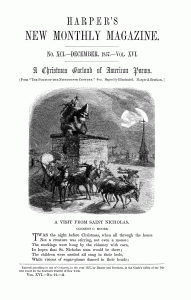
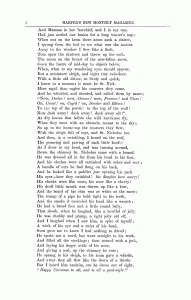
Click on thumbnails for full page view.
Printing tip: these images will print better when saved to your computer and printed locally, rather than printing directly from your browser.


Click on thumbnails for full page view.
Printing tip: these images will print better when saved to your computer and printed locally, rather than printing directly from your browser.
Monday, December 24, 2007
Queen Elizabeth's first-televised Christmas message, 1957
 I saw this morning that Queen Elizabeth's Christmas message will be airing on YouTube this year, as it did last year. This year marks the 50th Christmas that the Queen's greetings have been broadcast.
Let's jump back in time 50 years (five years before I was born) and have a look at the Queen's first televised Christmas message, from the land that gave us Victorian Santas and figgy pudding
Monday, December 10, 2007
A fine old tradition: Christmas Handbell Quartet
If you like the sound of bells, you'll love this--
[youtube=http://youtube.com/watch?v=E2H1UPQdipU]
[youtube=http://youtube.com/watch?v=E2H1UPQdipU]
Monday, December 3, 2007
Christmas is coming: feeling anxious yet?

I came across a pointed article by Carey Keavy, over at Associated Content, on the subject of taking back the holidays--
One Weird Christmas: Ditching Holiday Traditions That Bog Us Down
by Carey Keavy
"Did I remember to lock the door? Have you seen my kids lately? What color hair does my husband have? What was my name again?" What do all of these questions have in common? They all signify the ringing in of the hustle and bustle of the holidays, of course!
Along with the wholesome family traditions of the season comes the negative traditions we've come to know and expect...worry, busyness, stress and anxiety. Some of these traditions we've inherited from the examples of our parents. Some we've conjured up anew and all on our own. Wouldn't attempting to shed some of these negative holiday traditions this year be the best gift to give both to yourself and those around you? (read more)
Subscribe to:
Posts (Atom)